

Key takeaway: Short answer success comes from directly answering the question, using a clear structure, embedding evidence, and providing analysis rather than description.
Short answers can be the most challenging section to build confidence and strategies for success. In the following post we outline how to approach questions so you can give yourself the best opportunity to maximise your results.
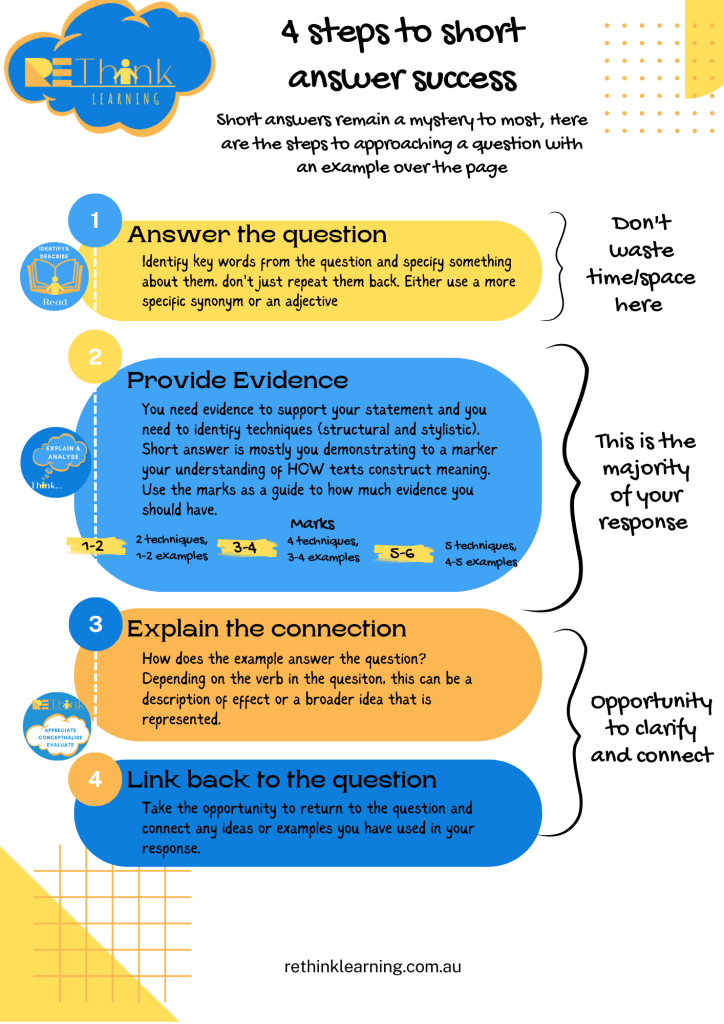
The 4 steps are:
- Answer the question
- Provide Evidence
- Explain the connection between the evidence and the question
- Link back to the question at the end
Step One: Answering the Question
Key idea: Don’t waste too much time or space. Do provide something new e.g. describe a characteristic of a keyword or an adjective for the text, or a key technique the text uses to achieve the idea.
E.g. How does the poem explore the power of storytelling?
The poet creates an authentic persona of a father to convey the ways storytelling can shape our sense of identity and inform our experiences.
Here I’ve addressed generally the idea of ‘how’ through the construction of the persona, added an evaluative adjective ‘authentic’ which goes beyond the demands of the question then added information on what the power of storytelling is ‘shapes our sense of identity to inform our experiences.’
Sometimes your questions will be more complex than this but the format is the same. An overall method the composer employs to create an idea. Just make sure you are attempting to specify what those things are.
Big tip: if you don’t nail it in the first sentence that’s ok, you can come back to it at the end. Do not spend three sentences attempting to explain your answer.
Step Two: Provide Evidence
This is the majority of your response. The main aim of short answer is really to assess your ability to analyse how texts create meaning. This means knowing key techniques and selecting good examples connected to your answer to the question. It’s key to combine at least one structural (macro) technique with stylistic (micro) techniques. The structural e.g. tone, characterisation, flashbacks etc. give you a discussion of the text as a whole. The stylistic techniques give you the opportunity to demonstrate specifics of the text choices. The big question is how much evidence, and here I suggest using the marks as a guide, try to provide about as many quotes as marks. You’ll see in the worked example below that his 5 mark question has 5 examples from the text in it.
Step Three: Explain the connection
This is an important aspect that you don’t need to spend too much time doing. Simply, every time you provide some evidence, bring it back to the question. This might only take half a sentence.
The symbolism of the “small fire that leaps and glows” represents the connection between the generations of men in the family, revealing how storytelling has the capacity to create connections and forge shared identities.
Here the explanation of the symbolism in the poem is furthered with an explicit comment about what it reveals about the power of storytelling. It only takes half a sentence, but it substantially improves the response and demonstrates the connection between the evidence and the answer to the question
Step Four: Link back to the question
It’s inevitable at some point that you might have strayed away from the question or you may not have provided the clearest answer in your first sentence. Use your last sentence to clarify and show the marker you know what you’re talking about. It should be a simple summary of your evidence and the relevance to the idea.

E.g. Through the construction of the father’s persona, Kissane expertly reveals how storytelling has the power to transform our perception of ourselves and the world.
I hope this helps you approach your short answers with more purpose. If you would like any more help with your HSC please don’t hesitate to reach out to john@rethinklearning.com.au
 RETHINK LEARNING
Leave a comment